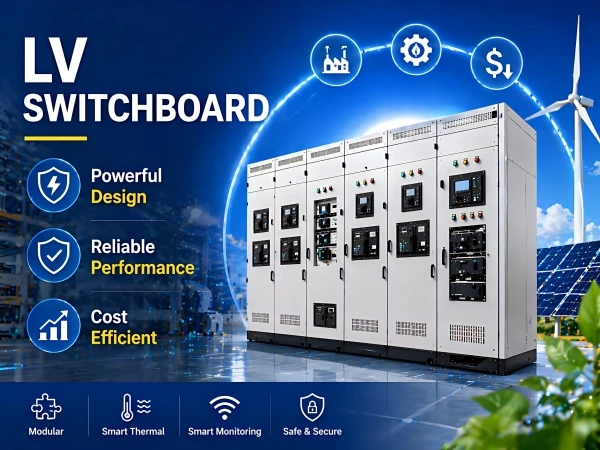
LV Switchboard Design
Introduction
Many facility managers and engineers grapple with a pressing problem: how to select or specify an LV switchboard that delivers rock-solid reliable performance without spiraling costs out of control. A weak or poorly thought-out LV switchboard design quickly turns into a nightmare—frequent downtime, unexpected maintenance bills, safety hazards, and project delays that can derail entire operations. The agitation grows when you realize that substandard choices often lead to cascading failures, regulatory fines, and lost productivity worth tens of thousands per hour. The solution lies in a smart, powerful LV switchboard design that balances robust architecture, intelligent protection, and cost-efficient engineering. This guide reveals exactly how to achieve it.
Table of Contents
- Understanding the LV Switchboard: Core Role in Modern Power Systems
- Why Powerful LV Switchboard Design Is the Cornerstone of Reliable Performance
- The Devastating Impacts of Poor LV Switchboard Design on Reliability and Costs
- Proven Strategies to Optimize LV Switchboard Design for Cost Control
- Key Components and Technologies That Drive LV Switchboard Reliability
- Advanced Techniques for Balancing Powerful Design, Reliable Performance, and Cost Efficiency in LV Switchboard
- Industry-Specific Applications: LV Switchboard Solutions Across Sectors
- Best Practices for LV Switchboard Installation, Maintenance, and Safety
- Future Trends and Innovations in LV Switchboard Design and Cost Management
- Actionable Checklist: Building Your Next High-Performance, Cost-Effective LV Switchboard
1.Understanding the LV Switchboard: Core Role in Modern Power Systems
What Is an LV Switchboard and Why It Matters
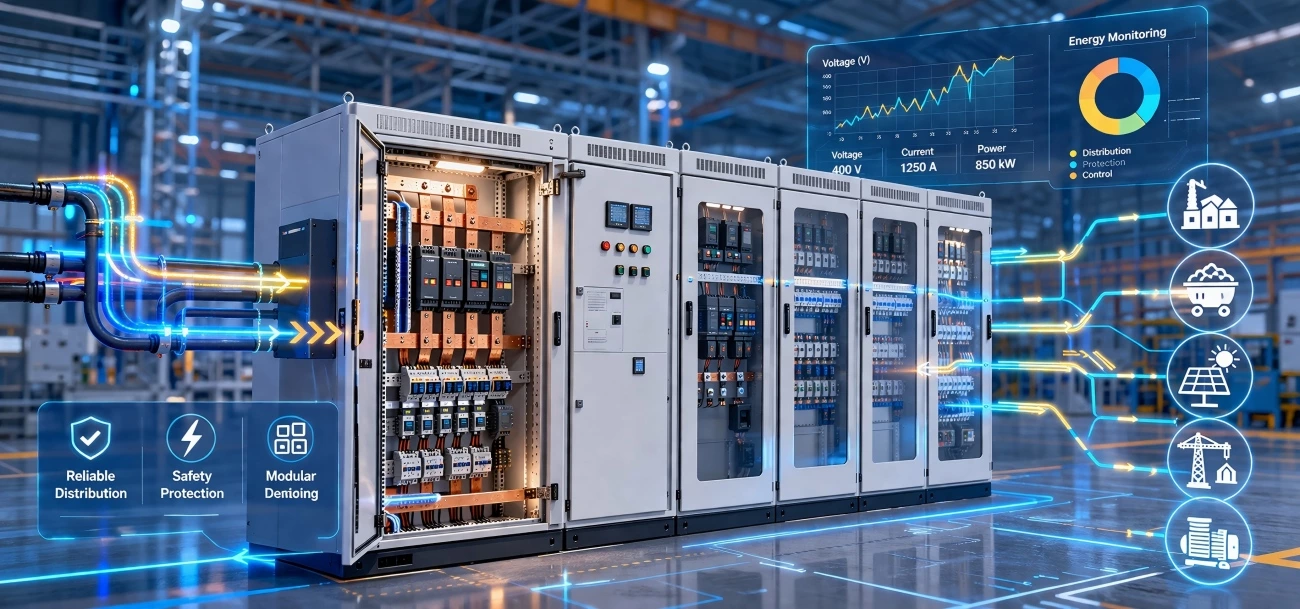
The LV switchboard serves as the central nervous system of low-voltage power distribution in countless facilities worldwide. In today’s fast-moving industrial landscape, the LV switchboard handles the safe and efficient flow of electricity from the main supply to every piece of equipment. Without a well-designed LV switchboard, even the most advanced machinery cannot operate reliably.
Engineers and project managers often face the same challenge: they need an LV switchboard that combines powerful performance with reasonable cost. The LV switchboard must accept incoming power, distribute it through multiple circuits, protect against faults, and allow easy monitoring and maintenance. A typical LV switchboard operates at voltages up to 1000V AC, carrying currents from hundreds to thousands of amperes depending on the application.
-
Core Functions of the LV Switchboard in Power Distribution
In modern power systems, the LV switchboard plays several critical roles. First, it provides reliable power distribution. Every factory, mine, construction site, farm, or renewable energy installation depends on steady electricity. The LV switchboard ensures that power reaches motors, lighting, control systems, and safety equipment without interruption.
Second, the LV switchboard offers essential protection. It houses circuit breakers, fuses, relays, and contactors that instantly disconnect faulty circuits to prevent fires, equipment damage, or electric shock.
Third, the LV switchboard enables intelligent control and monitoring. Modern LV switchboard designs often include smart meters, remote communication modules, and data acquisition systems. These features allow operators to track voltage, current, power factor, and energy consumption in real time. Such capabilities help reduce energy waste and support predictive maintenance programs.
-
Benefits of Modular Construction in LV Switchboard
The LV switchboard also supports modular construction. Instead of building a completely custom unit every time, manufacturers use standardized modules that can be quickly configured for different loads and environments. This approach dramatically shortens production time and lowers the overall cost of the LV switchboard while maintaining high quality.
-
Safety Standards and Compliance Requirements for LV Switchboard
From a safety perspective, the LV switchboard must meet strict international standards. Compliance with IEC 61439-1 and IEC 61439-2 ensures that the LV switchboard can withstand short-circuit forces, thermal stresses, and mechanical impacts. [Placeholder resource link: IEC 61439 Low-Voltage Switchgear and Controlgear Assemblies] Proper grounding, insulation, and enclosure protection (IP ratings) further enhance the LV switchboard’s ability to operate safely in harsh conditions such as dusty mines or humid agricultural facilities.
-
LV Switchboard Role in Energy Efficiency and Scalability
The LV switchboard also plays a key role in energy efficiency. By incorporating reactive power compensation, harmonic filters, and intelligent load management, the LV switchboard helps facilities lower electricity bills and meet sustainability targets. In new energy projects, the LV switchboard integrates seamlessly with battery storage systems, ensuring smooth power flow between generation, storage, and consumption.
Moreover, the LV switchboard supports scalability. As businesses grow, additional circuits or higher capacity can be added without replacing the entire unit. Modular LV switchboard designs make future expansions straightforward and budget-friendly.
-
LV Switchboard Applications Across Key Industrial Sectors
In practical terms, the LV switchboard forms the backbone of complete electrical automation solutions. Whether supplying power to heavy machinery in mining operations, controlling irrigation pumps in large-scale agriculture, powering cranes on construction sites, or managing inverters in solar and wind farms, the LV switchboard must deliver consistent performance day after day.
In the construction industry, the LV switchboard distributes power to temporary site offices, heavy equipment, and lighting systems. A reliable LV switchboard prevents costly delays caused by power failures during critical phases of building work.
In mining enterprises, the LV switchboard must withstand vibration, dust, and temperature swings. Robust LV switchboard architecture with vibration-resistant design and high IP-rated enclosures ensures continuous operation of crushers, conveyors, and ventilation systems.
Agricultural facilities rely on the LV switchboard to power irrigation pumps, grain dryers, and automated feeding systems. Here, the LV switchboard needs excellent corrosion resistance and weatherproof features to survive outdoor or humid environments.
For renewable energy projects, the LV switchboard connects solar arrays or wind turbines to the grid or local loads. It manages variable power input, protects sensitive inverters, and optimizes energy flow. Advanced LV switchboard designs with intelligent control features help maximize the return on investment in these green energy installations.
-
How Production and Sourcing Affect LV Switchboard Performance and Cost
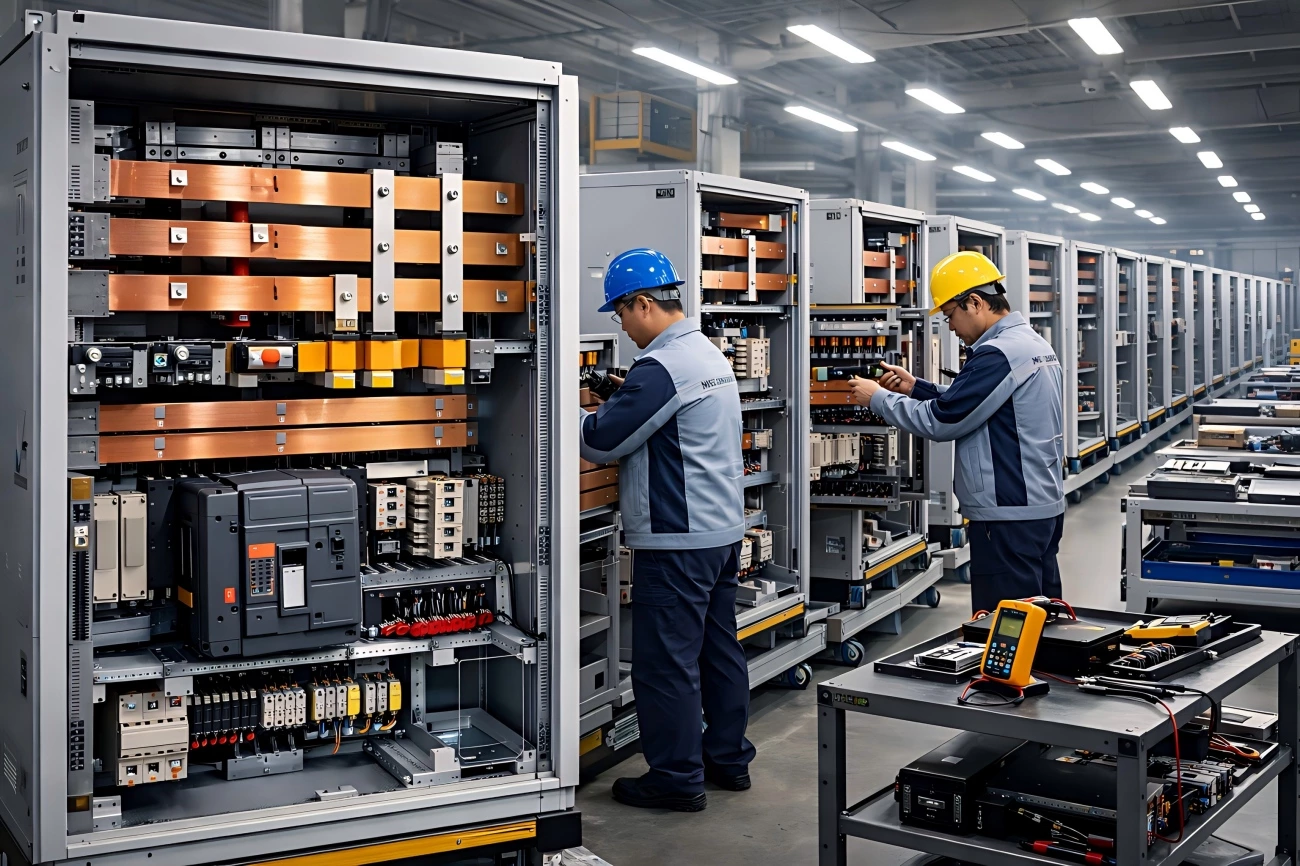
Production techniques play a vital role too. Modern LV switchboard manufacturing employs automated assembly lines, precision punching, and strict quality testing protocols. These methods ensure every LV switchboard leaving the factory meets consistent performance standards while keeping manufacturing costs competitive.
Sourcing the right LV switchboard requires attention to supply chain reliability. Reputable LV switchboard manufacturers offer clear documentation, international certifications, and transparent pricing strategies. Buyers benefit from working directly with factories that provide OEM and ODM services, allowing customization without excessive cost premiums.
2.Why Powerful LV Switchboard Design Is the Cornerstone of Reliable Performance
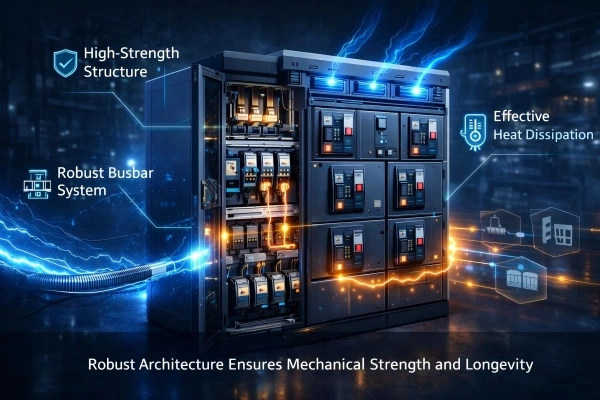
Robust Architecture Ensures Mechanical Strength and Longevity
A powerful LV switchboard design begins with a solid structural foundation. The enclosure and frame must withstand mechanical stresses, vibrations, and environmental challenges common in industrial settings. High-quality steel or aluminum sheets with proper reinforcement create a rigid LV switchboard structure that resists deformation over years of service. This mechanical strength directly translates into fewer failures and longer operational life for the entire LV switchboard.
Strategic Busbar System Design for Superior Current Handling
The heart of any powerful LV switchboard lies in its busbar arrangement. Engineers carefully calculate busbar cross-section, spacing, and support insulators to handle rated currents and short-circuit forces without overheating or mechanical damage. A well-designed busbar system in the LV switchboard maintains low impedance, reduces power losses, and ensures even current distribution across all outgoing circuits. This design choice forms the backbone of stable and reliable performance under varying load conditions.
Intelligent Thermal Management in LV Switchboard Design
Heat is one of the biggest enemies of electrical equipment. Powerful LV switchboard design incorporates effective ventilation paths, heat dissipation channels, and temperature monitoring points. By optimizing airflow and component placement, the LV switchboard prevents hot spots that could degrade insulation or trigger nuisance tripping. Proper thermal management keeps the LV switchboard running cool even during peak summer loads or continuous heavy-duty operation.
Protection Coordination and Selectivity Principles
Reliable performance demands precise protection coordination within the LV switchboard. Designers select and set circuit breakers, fuses, and relays so that only the faulty circuit is isolated while the rest of the system continues operating. This selectivity ensures maximum uptime. A powerful LV switchboard design carefully studies time-current curves and implements zone-selective interlocking where needed, delivering both safety and continuity.
Modular and Flexible Layout for Easy Expansion
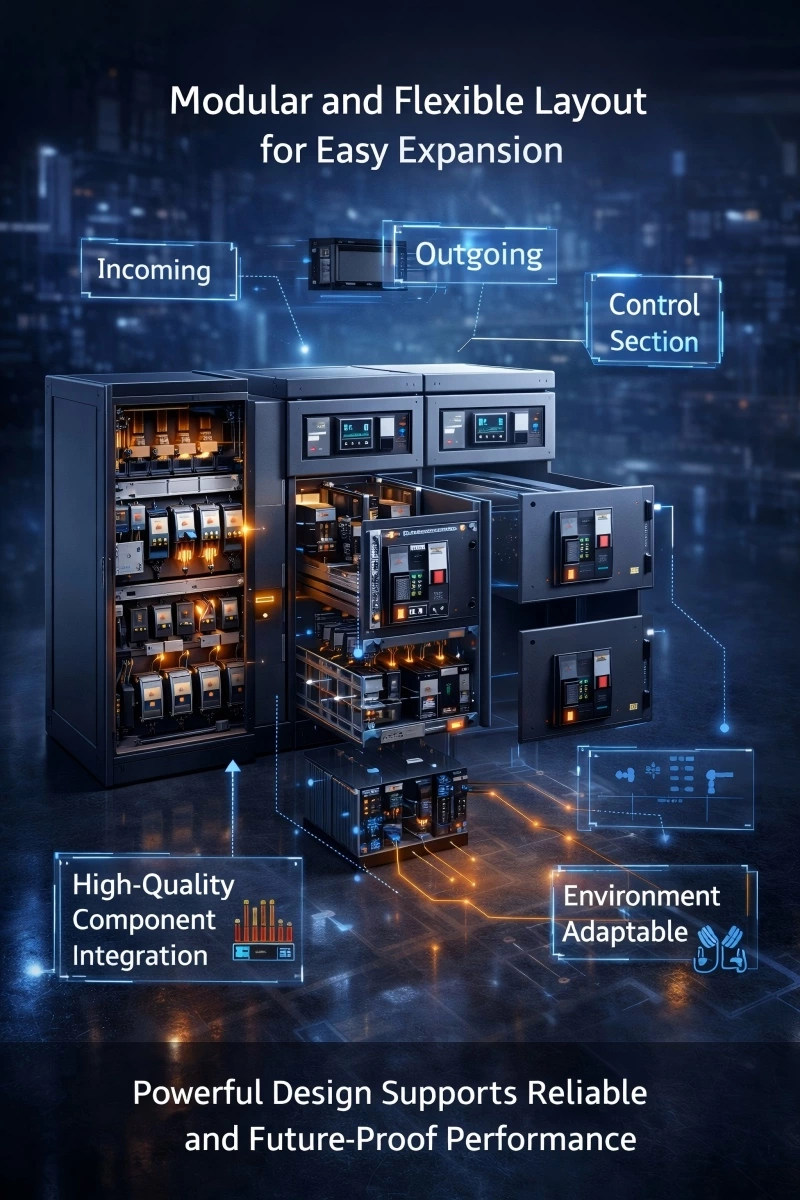
Modern powerful LV switchboard design embraces modularity. Standardized compartments for incoming, outgoing, and control sections allow quick reconfiguration when production needs change. This flexibility means the LV switchboard can grow with the facility without requiring complete replacement, maintaining reliable performance throughout its service life while avoiding major capital outlays.
High-Quality Component Integration and Layout Optimization
Every element inside the LV switchboard must work in harmony. Powerful design pays close attention to cable routing, separation of power and control circuits, and clear labeling. Proper segregation reduces electromagnetic interference and makes future maintenance safer and faster. Thoughtful panel layout in the LV switchboard minimizes wiring errors during assembly and improves overall system reliability.
Environmental Adaptability Features in LV Switchboard Design
Industrial environments vary widely. A powerful LV switchboard design accounts for dust, moisture, corrosive gases, and extreme temperatures by selecting appropriate IP-rated enclosures, anti-corrosion coatings, and special sealing techniques. These features ensure the LV switchboard continues to deliver reliable performance whether installed in a humid agricultural facility, a dusty mining site, or a coastal renewable energy plant.
Testing and Validation Protocols for LV Switchboard Reliability
Before leaving the factory, every powerful LV switchboard undergoes rigorous type tests and routine tests. These include dielectric withstand, temperature rise, short-circuit withstand, and mechanical operation tests. A design that has been thoroughly validated gives operators confidence that the LV switchboard will perform reliably under real-world conditions for decades.
Impact of Design on Operational Efficiency
When the LV switchboard features a powerful design, energy losses stay minimal, power factor remains optimized, and harmonic distortion stays controlled. Operators experience fewer unplanned shutdowns, smoother motor starting, and more stable voltage levels. All these factors combine to boost overall plant productivity and reduce operating costs indirectly through higher reliability.
This powerful LV switchboard design philosophy directly supports uninterrupted power supply across critical applications, making it the true cornerstone of reliable performance in modern electrical systems.
3.The Devastating Impacts of Poor LV Switchboard Design on Reliability and Costs
- Frequent Downtime and Production Losses
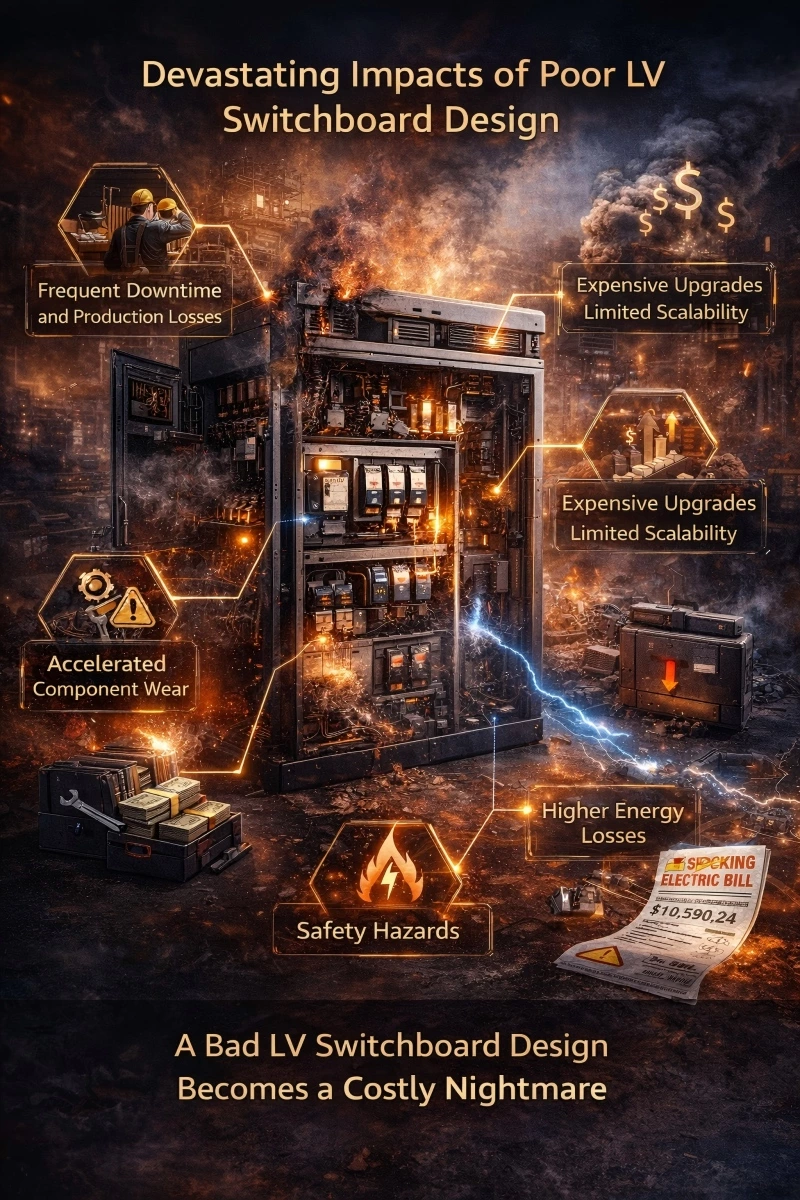
A poor LV switchboard design quickly leads to unexpected breakdowns. When the enclosure lacks sufficient rigidity or the busbar system is undersized, even minor load fluctuations can cause overheating or mechanical failure. The LV switchboard then trips repeatedly or fails completely, halting entire production lines for hours or days. In mining or manufacturing plants, every hour of downtime can cost thousands of dollars in lost output, making unreliable LV switchboard performance extremely expensive.
-
Accelerated Component Wear and Premature Failure
Inadequate thermal management in a badly designed LV switchboard creates persistent hot spots. Circuit breakers, contactors, and insulation materials degrade much faster than they should. Relays may stick, fuses blow too often, and busbars deform under repeated thermal stress. As a result, the LV switchboard requires frequent part replacements long before its expected service life, driving up maintenance budgets and disrupting operations.
-
Safety Hazards and Regulatory Violations
Weak LV switchboard design often ignores proper protection coordination or uses inferior enclosure materials. This increases the risk of arc flash, electric shock, or fire. Short-circuit forces can rip apart poorly supported components, endangering workers and damaging surrounding equipment. Facilities may face heavy fines, shutdown orders, or lawsuits when the LV switchboard fails to meet basic safety standards, turning a design flaw into a major legal and financial liability.
-
Skyrocketing Maintenance and Repair Costs
Poorly laid out wiring, crowded compartments, and unclear labeling make troubleshooting extremely difficult. Technicians spend far more time locating faults in a badly designed LV switchboard, increasing labor costs. Replacement parts become more expensive because non-standard or low-quality components fail repeatedly. Over time, the cumulative maintenance expense of a flawed LV switchboard far exceeds the initial savings from choosing a cheap option.
-
Higher Energy Losses and Increased Electricity Bills
An undersized or poorly configured busbar system in the LV switchboard generates excessive resistance and heat. This leads to higher power losses and lower power factor. Harmonic distortion may also rise if filtering is neglected. The result is inflated monthly electricity bills and wasted energy that could have been avoided with a properly engineered LV switchboard.
-
Limited Scalability and Expensive Future Upgrades
A non-modular or inflexible LV switchboard design leaves no room for expansion. When production capacity grows or new equipment is added, the entire LV switchboard often needs replacement rather than simple modification. This creates sudden large capital expenditures and lengthy project delays, severely impacting budget planning and return on investment.
-
Reputation Damage and Lost Business Opportunities
Repeated power interruptions caused by an unreliable LV switchboard damage a company’s reputation with clients and partners. In construction projects or renewable energy installations, contractors who experience frequent LV switchboard failures may lose future contracts. End users in agriculture or industry begin to question the quality of the entire electrical system, making it harder to win new business.
-
Environmental and Operational Inefficiencies
A substandard LV switchboard struggles in harsh conditions such as dust, humidity, or vibration. Corrosion accelerates, seals fail, and dust accumulation causes tracking or short circuits. The LV switchboard then operates inefficiently, consuming more energy while providing less protection. These hidden inefficiencies compound over time, turning a seemingly minor design shortcut into a major long-term cost burden.
-
Chain Reaction Failures Across the Power System
The worst impact of poor LV switchboard design is its cascading effect. A single weak point can trigger widespread outages, damage connected motors, inverters, or control systems, and require complete system resets. What begins as a problem inside the LV switchboard quickly spreads, multiplying repair costs and downtime far beyond the switchboard itself.
These devastating impacts demonstrate why cutting corners on LV switchboard design is never a smart economy. A flawed LV switchboard does not save money — it quietly drains resources through constant problems, safety risks, and lost productivity.
4.Proven Strategies to Optimize LV Switchboard Design for Cost Control
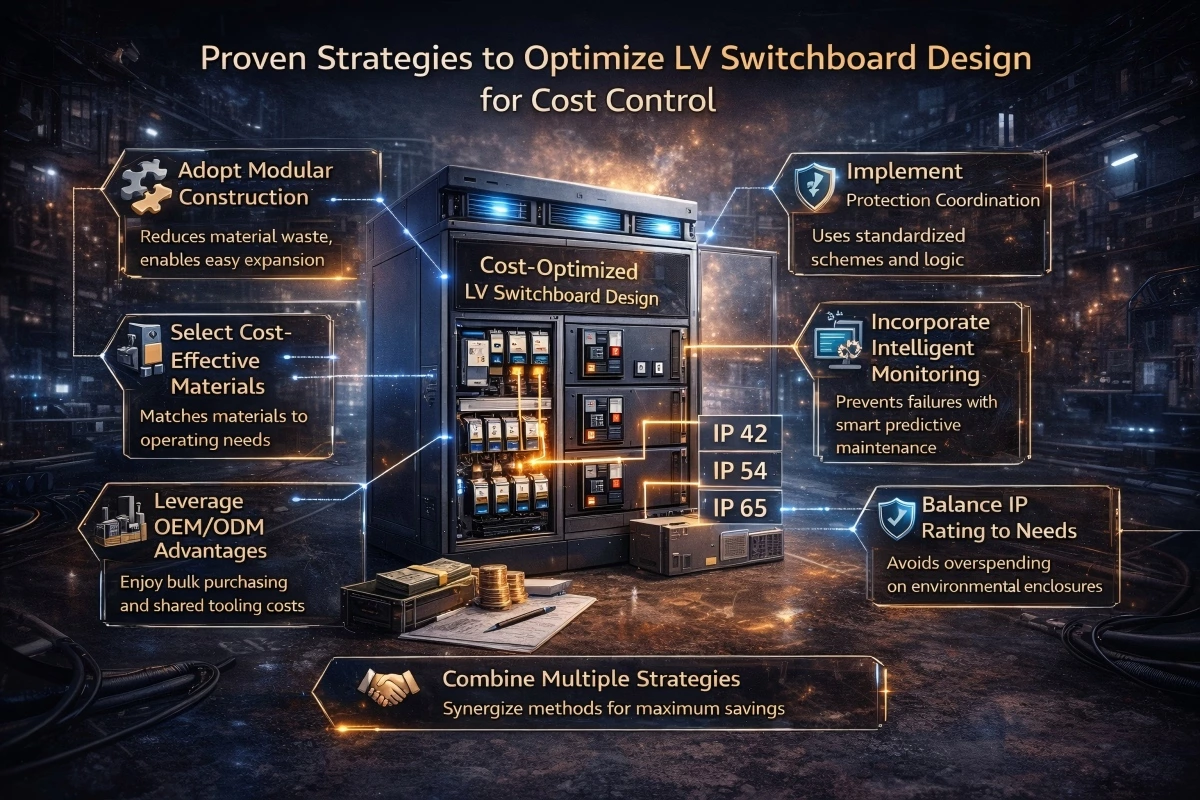
Adopt Modular Construction to Reduce Material Waste
One of the most effective ways to control costs is through modular LV switchboard design. Standardized compartments and plug-in units allow manufacturers to use common parts across different projects. This approach cuts down on custom fabrication, reduces scrap material, and shortens assembly time. As a result, the overall price of the LV switchboard drops significantly while still delivering high performance and easy future upgrades.
Select Cost-Effective Yet High-Quality Materials
Powerful LV switchboard design does not require the most expensive materials everywhere. Smart engineers choose optimal grades of steel for enclosures, high-conductivity copper or aluminum for busbars, and proven insulation systems that meet required standards. By matching material specifications precisely to actual operating conditions, the LV switchboard achieves excellent reliability without unnecessary cost premiums.
Optimize Busbar and Wiring Layout for Lower Losses
Careful calculation of busbar cross-sections and intelligent routing of cables can dramatically reduce power losses inside the LV switchboard. Shorter, straighter busbar runs and proper phase arrangement minimize resistance and heat generation. These small but critical design decisions lower energy consumption over the LV switchboard’s lifetime and reduce the need for oversized cooling systems, directly saving on both initial and operating costs.
Implement Standardized Protection Coordination
Using well-proven protection schemes and off-the-shelf circuit breakers with appropriate settings simplifies the LV switchboard design process. Instead of developing fully custom logic for every project, designers apply standardized selectivity tables and zone protection principles. This reduces engineering hours, testing time, and the risk of expensive redesigns, keeping the final LV switchboard price competitive.
Leverage OEM and ODM Manufacturing Advantages
Working directly with experienced LV switchboard manufacturers who offer OEM and ODM services brings clear cost benefits. Factories can optimize production processes, bulk-purchase components, and share tooling costs across multiple orders. Customers receive a tailored LV switchboard at a lower unit price while benefiting from consistent quality and shorter lead times.。
Incorporate Intelligent Monitoring to Cut Long-Term Expenses
Adding affordable smart modules for remote monitoring and predictive maintenance can significantly lower the total cost of ownership of the LV switchboard. Early detection of abnormal temperature, vibration, or contact wear prevents sudden failures. This proactive approach reduces unplanned downtime and emergency repair bills, making the initial investment in a well-designed LV switchboard pay for itself many times over.
Design for Easy Installation and Maintenance Access
A cost-optimized LV switchboard features front-access doors, clear labeling, and logical component placement. These details speed up on-site installation and routine servicing. Technicians complete work faster, reducing labor costs and minimizing production interruptions. Simple design choices like this often deliver the biggest savings in real-world operation.
Balance IP Rating and Environmental Protection
Choosing the right degree of protection (IP rating) for the LV switchboard enclosure avoids over-specification. A dusty indoor factory may only need IP42, while a mining site might require IP65. Matching the enclosure exactly to site conditions prevents paying for unnecessary features, keeping the LV switchboard price reasonable without compromising reliability.
Perform Value Engineering During the Design Phase
Systematic value engineering reviews help identify areas where the LV switchboard can be simplified without sacrificing performance. Teams evaluate every component and ask whether a lower-cost alternative can meet the same technical requirements. This disciplined process routinely uncovers 10-20% cost savings while maintaining or even improving the overall reliability of the LV switchboard.
Combine Multiple Strategies for Maximum Savings
The most successful cost control comes from applying several of these strategies together. Modular construction paired with optimized material selection, intelligent monitoring, and efficient manufacturing creates a powerful yet affordable LV switchboard. Facilities that follow this integrated approach enjoy lower upfront prices, reduced operating costs, and dependable long-term performance.
These proven strategies show that optimizing LV switchboard design for cost control does not mean compromising quality. Instead, it delivers a smarter, more competitive LV switchboard that supports reliable operation while protecting project budgets.
5.Key Components and Technologies That Drive LV Switchboard Reliability
High-Performance Circuit Breakers for Instant Fault Protection
Circuit breakers form the first line of defense in any LV switchboard. Modern molded-case or air-circuit breakers with adjustable trip settings react in milliseconds to overcurrent, short-circuit, or ground-fault conditions. Their precise coordination ensures the LV switchboard isolates problems without affecting healthy circuits, delivering uninterrupted power to critical loads.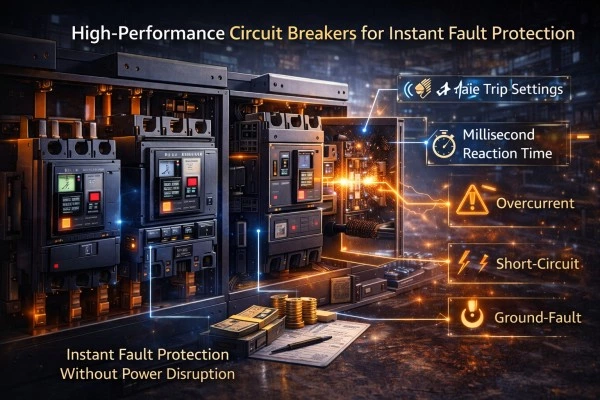
Durable Contactors and Switching Devices
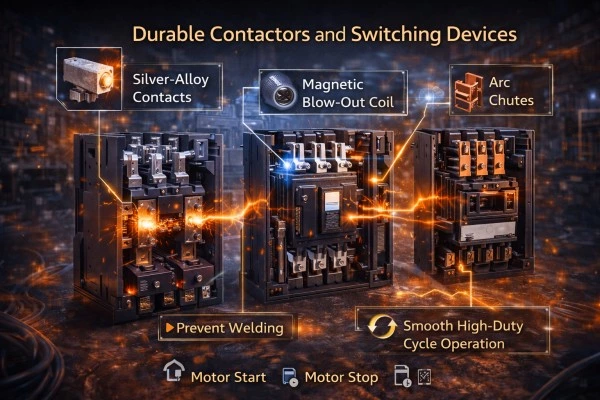
Contactors manage frequent motor starts and stops within the LV switchboard. Silver-alloy contacts, magnetic blow-out coils, and arc chutes extend mechanical and electrical life. When integrated correctly, these components prevent welding or excessive arcing, maintaining smooth operation even in high-duty-cycle industrial applications.
High-Quality Insulation and Enclosure Materials
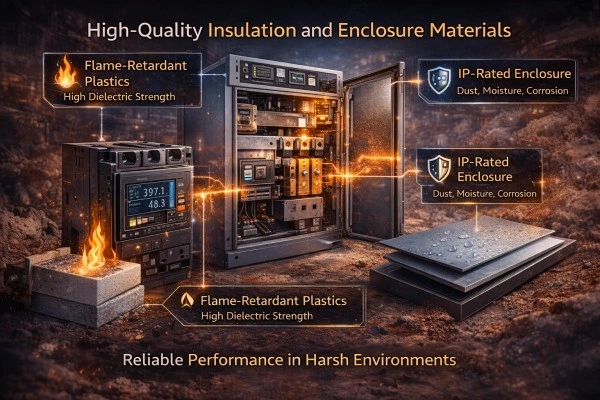
Insulation materials and enclosure panels directly affect long-term reliability of the LV switchboard. Flame-retardant, high-dielectric-strength plastics and powder-coated steel sheets resist moisture, dust, and corrosion. Proper IP-rated enclosures protect internal components, ensuring the LV switchboard performs consistently in harsh mining, agricultural, or outdoor environments.
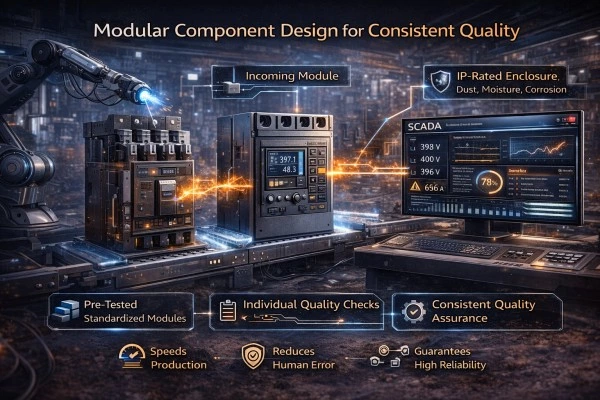
Modular Component Design for Consistent Quality
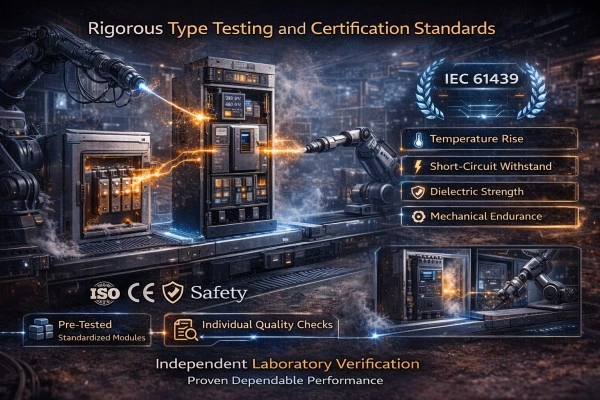
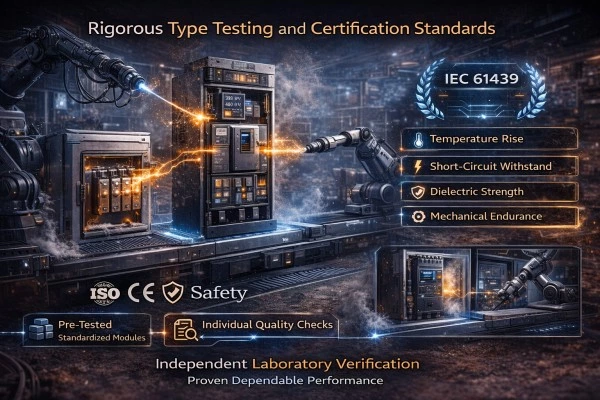
Modular construction lets manufacturers assemble the LV switchboard from pre-tested, standardized blocks. Each module undergoes individual quality checks before integration. This technology reduces human error, speeds production, and guarantees every LV switchboard meets the same high reliability standards regardless of configuration.
Rigorous Type Testing and Certification Standards
Every reliable LV switchboard design undergoes IEC 61439 type tests for temperature rise, short-circuit withstand, dielectric strength, and mechanical endurance.Independent laboratory verification confirms that the components and technologies chosen will deliver dependable performance in real-world service.
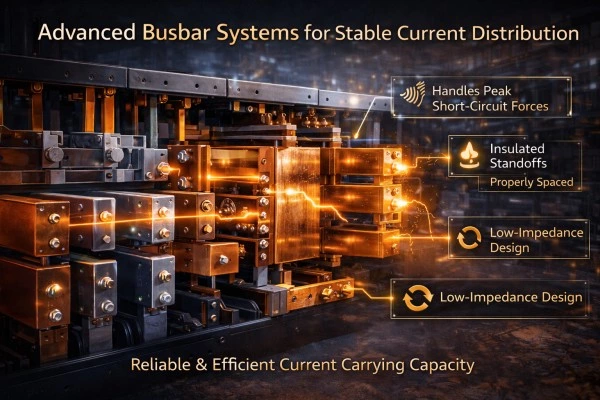
Advanced Busbar Systems for Stable Current Distribution
The busbar system carries the main current inside the LV switchboard. High-conductivity copper or aluminum bars, supported by insulated standoffs and properly spaced, handle both continuous rated current and peak short-circuit forces. Low-impedance design reduces voltage drop and heat buildup, keeping the entire LV switchboard operating reliably under full load for decades.
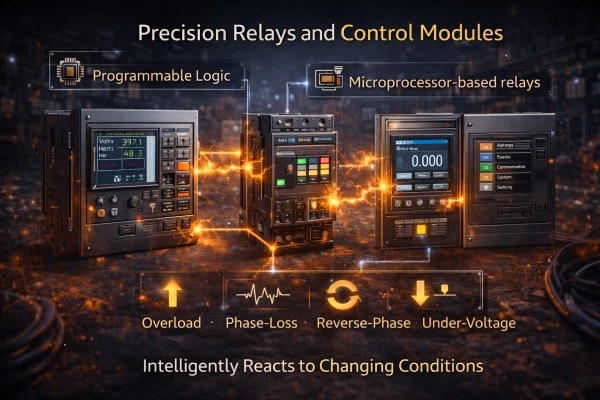
Precision Relays and Control Modules
Relays and digital protection relays monitor voltage, current, frequency, and power quality inside the LV switchboard. They provide overload, phase-loss, reverse-phase, and under-voltage protection. Microprocessor-based relays add programmable logic, enabling the LV switchboard to react intelligently to changing conditions before faults escalate.
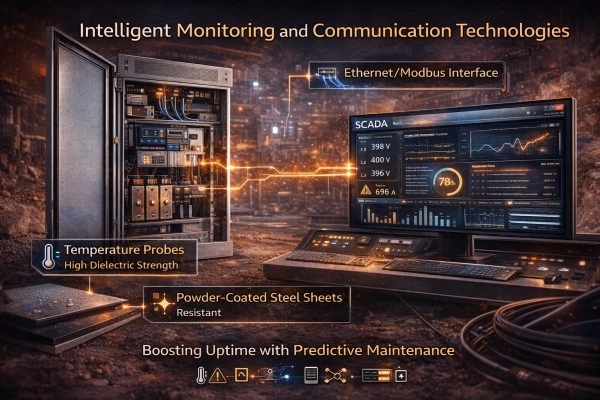
Intelligent Monitoring and Communication Technologies
Smart sensors and communication modules turn the LV switchboard into an active monitoring hub. Temperature probes, current transformers, and Ethernet or Modbus interfaces feed real-time data to SCADA systems. Early warnings for abnormal conditions allow predictive maintenance, dramatically increasing overall LV switchboard uptime.
Comprehensive Protection Coordination Technologies
Zone-selective interlocking and time-graded protection schemes ensure correct selectivity across the LV switchboard. These technologies prevent unnecessary upstream tripping and limit the impact of any single fault. When combined with high breaking-capacity devices, they keep the LV switchboard and connected equipment safe and operational.
These key components and technologies work together as an integrated system. When properly selected and engineered, they make the LV switchboard a dependable powerhouse that supports continuous operation across demanding industrial environments.
6.Advanced Techniques for Balancing Powerful Design, Reliable Performance, and Cost Efficiency in LV Switchboard
-
Simulation-Driven Design Optimization
Advanced finite-element analysis and thermal-electromagnetic simulation software now allow engineers to test LV switchboard designs virtually before any metal is cut. By modeling busbar heating, short-circuit forces, and airflow patterns, designers can fine-tune dimensions and component placement. This technique eliminates over-engineering, reduces material usage by up to 15 %, and still guarantees the LV switchboard meets exact performance requirements.
-
Hybrid Modular-Flexible Architecture
Combining standardized modular sections with custom plug-in functional units creates a powerful yet cost-efficient LV switchboard. Pre-tested modules handle common power distribution tasks while flexible bays accommodate site-specific needs. The result is faster assembly, lower inventory costs, and the ability to scale or reconfigure the LV switchboard without full replacement, striking the perfect balance between reliability and budget control.
-
Lifecycle Cost Analysis Integrated into Early Design
Modern LV switchboard design teams perform detailed lifecycle cost calculations from the very first drawing. They weigh initial purchase price against projected energy losses, maintenance intervals, and expected service life. By selecting components that deliver the lowest total ownership cost, the LV switchboard achieves powerful performance and long-term reliability without inflating upfront expenses.
-
Smart Sensor Integration for Predictive Maintenance
Affordable IoT sensors embedded directly into the LV switchboard monitor temperature, vibration, humidity, and contact wear in real time. Data feeds into cloud-based analytics that predict failures weeks in advance. This advanced technique reduces unplanned downtime by 30-40 % while allowing the use of standard-grade components instead of ultra-premium ones, keeping costs under control.
-
Value Engineering Workshops with Cross-Functional Teams
Structured value-engineering sessions bring designers, production engineers, and procurement specialists together to challenge every element of the LV switchboard. They ask whether a lower-cost material or simplified assembly method can still meet IEC 61439 requirements. These workshops routinely uncover 10-20 % savings while preserving or even enhancing mechanical strength and electrical reliability.
-
Optimized Protection Coordination Algorithms
Digital protection relays with programmable logic replace traditional hard-wired schemes in advanced LV switchboard designs. Engineers implement adaptive coordination curves that automatically adjust to changing loads. This delivers superior fault selectivity and system uptime at a fraction of the cost of fully custom relay panels.
-
Energy-Efficient Component Selection Strategies
By specifying low-loss busbar coatings, high-efficiency contactors, and active power-factor correction modules, the LV switchboard reduces internal heat and energy waste. These choices improve overall efficiency without requiring oversized cooling systems, delivering both powerful performance and measurable cost savings on electricity bills.
-
Automated Quality Assurance in Manufacturing
State-of-the-art robotic welding, automated busbar punching, and inline dielectric testing ensure every LV switchboard leaving the line meets the same high standards. Automation cuts labor costs and human error while maintaining the robust design integrity needed for reliable long-term operation.
-
Material Substitution Based on Application-Specific Data
Advanced techniques now use real-world environmental data to substitute materials intelligently. For indoor installations, lighter galvanized steel replaces stainless in non-corrosive areas; for mining sites, reinforced composites extend enclosure life. This data-driven substitution keeps the LV switchboard powerful and reliable while trimming unnecessary material expenses.
-
Integrated Design-for-Maintenance Principles
Final advanced technique focuses on accessibility. Hinged doors, color-coded wiring, and standardized test points built into the LV switchboard reduce service time by half. Shorter maintenance windows mean lower labor costs and less production interruption, completing the balance of powerful design, reliable performance, and cost efficiency.
These advanced techniques prove that powerful LV switchboard design, reliable performance, and cost efficiency are not competing goals but can be achieved simultaneously through smart engineering.
7..Industry-Specific Applications: LV Switchboard Solutions Across Sectors
LV Switchboard Solutions for Mining Operations
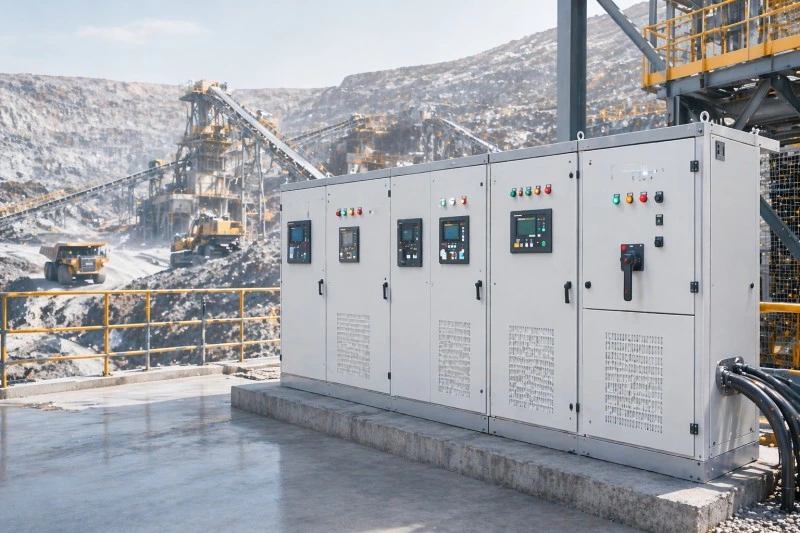
Mining environments demand rugged LV switchboard designs that withstand constant vibration, heavy dust, and temperature swings. The LV switchboard powers crushers, conveyors, ventilation fans, and pumping stations with high current-carrying capacity and short-circuit withstand ratings. Robust enclosures with IP65 protection and anti-corrosion coatings ensure the LV switchboard operates reliably 24/7, preventing costly production stoppages in remote underground or open-pit sites.
LV Switchboard Solutions for Construction Projects
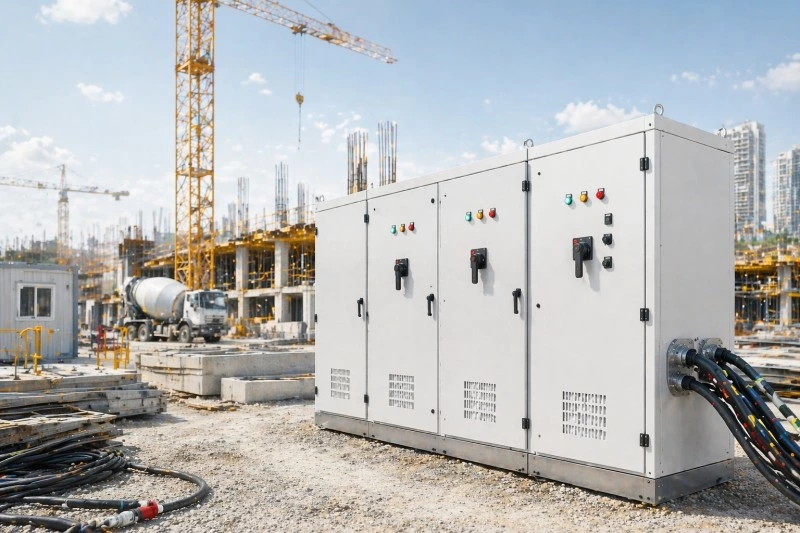
On construction sites the LV switchboard serves as a mobile and scalable power hub. It distributes electricity to tower cranes, concrete batching plants, temporary offices, and lighting systems. Compact, modular LV switchboard designs allow quick relocation between phases of a project while delivering stable voltage and overload protection, helping contractors meet tight schedules without power-related delays.
LV Switchboard Solutions for Agricultural Facilities
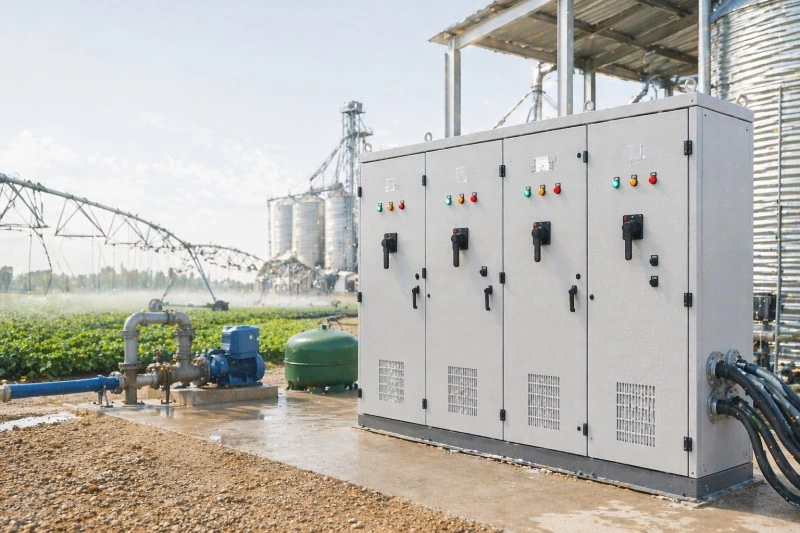
Agricultural operations rely on the LV switchboard to control irrigation pumps, grain dryers, automated feeding systems, and cold storage units. Weatherproof LV switchboard enclosures with high IP ratings and corrosion-resistant materials protect against humidity, dust, and outdoor exposure. Intelligent load management within the LV switchboard optimizes energy use during peak irrigation seasons, keeping operating costs low for large-scale farms.
LV Switchboard Solutions for Renewable Energy Installations
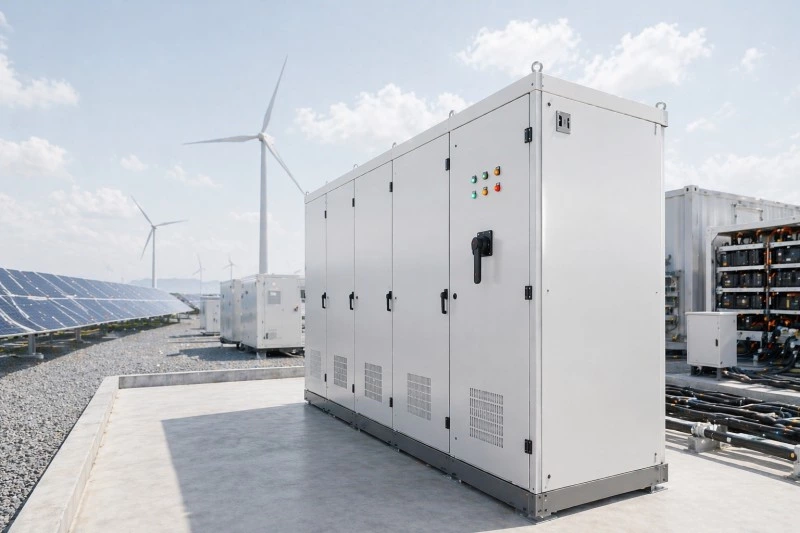
In solar farms and wind power plants the LV switchboard connects inverters, battery storage, and grid tie-points. It manages variable power input, provides rapid fault isolation, and supports power factor correction. Advanced LV switchboard designs with remote monitoring capabilities ensure maximum energy yield and seamless integration with energy storage systems, making renewable projects more profitable and reliable.
LV Switchboard Solutions for General Industrial Manufacturing
Manufacturing plants use the LV switchboard to supply motors, PLC control panels, robotic assembly lines, and HVAC systems. The LV switchboard’s flexible configuration supports frequent production line changes while maintaining precise protection coordination. High-reliability components and modular layouts allow factories to expand capacity without replacing the entire power distribution system, supporting continuous operation across diverse industries.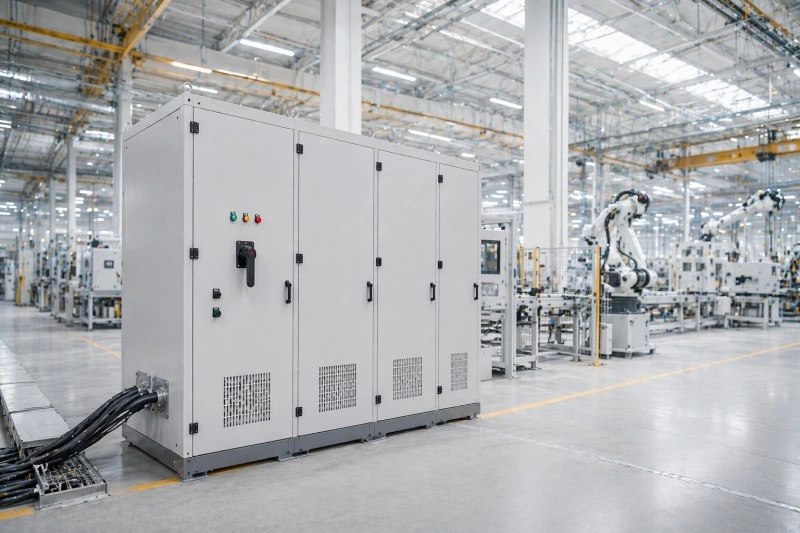
LV Switchboard Solutions for New Energy and Hybrid Systems
Emerging hybrid facilities that combine traditional power with microgrids depend on the LV switchboard for seamless switching between sources. The LV switchboard integrates ATS units, reactive power compensation, and harmonic filters to maintain stable voltage and frequency. This specialized application ensures reliable performance during peak demand or grid outages, helping facilities achieve both energy independence and cost savings.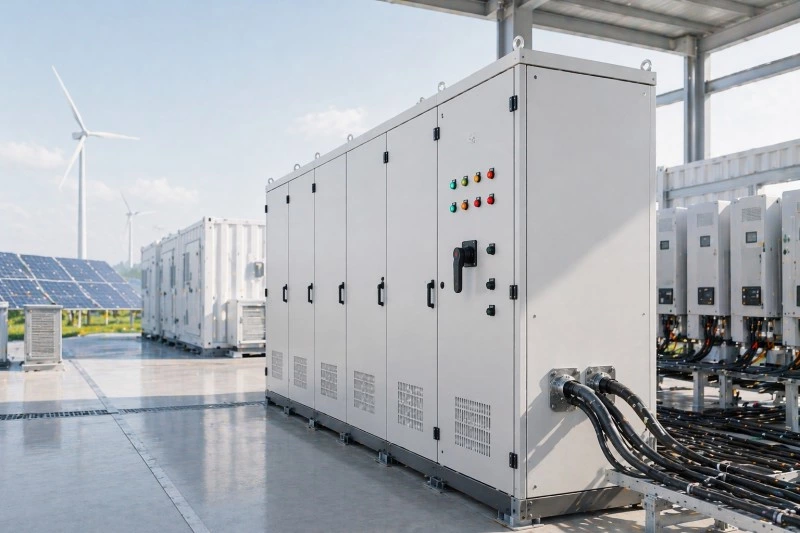
These industry-specific LV switchboard solutions demonstrate how tailored design choices deliver powerful reliability exactly where it is needed most, across mining, construction, agriculture, renewable energy, and manufacturing sectors.
8.Best Practices for LV Switchboard Installation, Maintenance, and Safety
Pre-Installation Planning and Site Preparation
Successful LV switchboard deployment begins long before the first bolt is tightened. Engineers must verify foundation levelness, adequate ventilation space, and proper cable entry routes. Clearances around the LV switchboard must meet manufacturer drawings and local codes to allow safe door opening and heat dissipation. Proper planning prevents costly rework and ensures the LV switchboard operates reliably from day one.
Safe and Correct LV Switchboard Installation Procedures
Installation teams follow a step-by-step lifting and positioning protocol using certified rigging equipment. Busbar joints receive torque verification with calibrated tools, and all power and control cables are dressed neatly with proper supports. Grounding connections are tested for continuity before any power is applied. These disciplined procedures protect the LV switchboard from mechanical damage and establish a safe electrical bond.
Commissioning and Initial Testing Best Practices
After physical installation, the LV switchboard undergoes comprehensive commissioning. Insulation resistance, primary injection, and functional tests confirm that protection devices operate exactly as designed. Engineers verify phase rotation, interlocks, and remote signaling before energizing the system. Thorough commissioning catches issues early and confirms the LV switchboard will deliver reliable performance under load.
Routine Maintenance Schedules and Procedures
A documented preventive maintenance schedule keeps the LV switchboard in peak condition. Quarterly visual inspections check for dust accumulation, loose connections, and overheating signs. Annual torque checks on busbars and cleaning of contact surfaces extend component life. Following the schedule minimizes unexpected failures and keeps maintenance costs predictable.
Predictive Maintenance Using Modern Tools
Modern best practices integrate thermal imaging, partial discharge monitoring, and vibration sensors into the LV switchboard maintenance routine. Data collected during normal operation flags rising temperatures or unusual noise before failure occurs. This predictive approach reduces emergency repairs and allows planned outages at the most convenient times.
Safety Protocols During Operation and Servicing
Lockout-tagout procedures are mandatory whenever work is performed inside the LV switchboard. Personnel wear appropriate arc-flash PPE and use insulated tools. Only qualified electricians trained on the specific LV switchboard design perform internal adjustments. Clear warning labels and one-line diagrams posted on the LV switchboard doors reinforce safe work practices every day.
Emergency Response and Fault Clearing Best Practices
When a fault occurs, operators follow a predefined emergency response plan. The LV switchboard’s zone-selective interlocking isolates the problem quickly while keeping upstream power intact. Post-fault inspection includes checking for arc damage and verifying all protection settings before re-energizing. These practices limit the impact of incidents and restore operations safely and rapidly.
Documentation and Record-Keeping for Long-Term Safety
Complete as-built drawings, test reports, and maintenance logs must remain with the LV switchboard throughout its service life. Digital records stored in a cloud system allow instant access during audits or troubleshooting. Accurate documentation supports compliance with international standards and simplifies future upgrades or expansions of the LV switchboard.
Personnel Training Requirements
Regular training ensures every technician understands the LV switchboard’s unique features and safety interlocks. Hands-on sessions cover proper racking of breakers, use of test switches, and recognition of abnormal conditions. Well-trained teams operate and maintain the LV switchboard more efficiently and with greater confidence.
Following these best practices for LV switchboard installation, maintenance, and safety transforms the equipment from a simple power distribution unit into a dependable, long-lasting asset that protects both people and production.
9.Future Trends and Innovations in LV Switchboard Design and Cost Management
AI-Driven Automated Design Platforms
Artificial intelligence is transforming LV switchboard design. Advanced algorithms now generate optimal layouts, busbar configurations, and protection schemes in minutes instead of weeks. These platforms analyze thousands of variables including load profiles, environmental conditions, and cost targets, producing powerful yet economical LV switchboard designs that meet IEC standards while cutting engineering time and material waste.
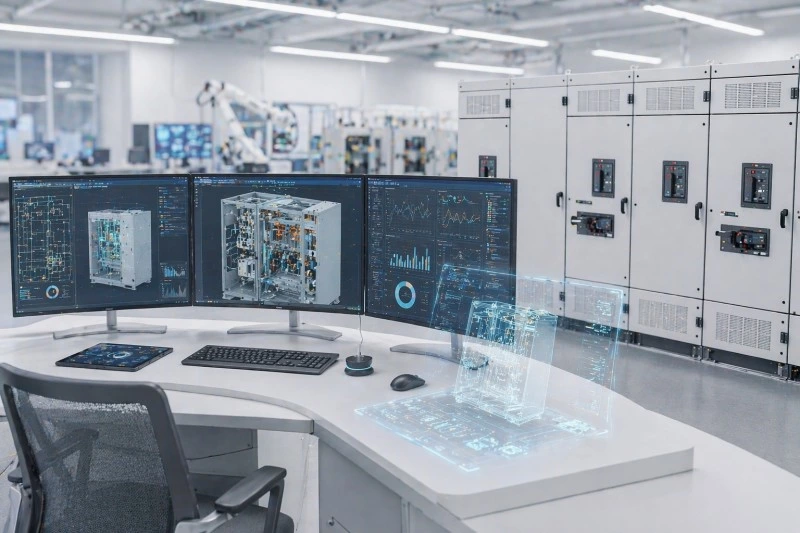

Digital Twin Technology for Real-Time Simulation
Digital twins create a virtual replica of the physical LV switchboard. Engineers and operators can simulate faults, load changes, or aging effects before they occur in the real world. This innovation allows predictive cost management by identifying the most economical upgrade paths and extending the LV switchboard service life without expensive trial-and-error testing.
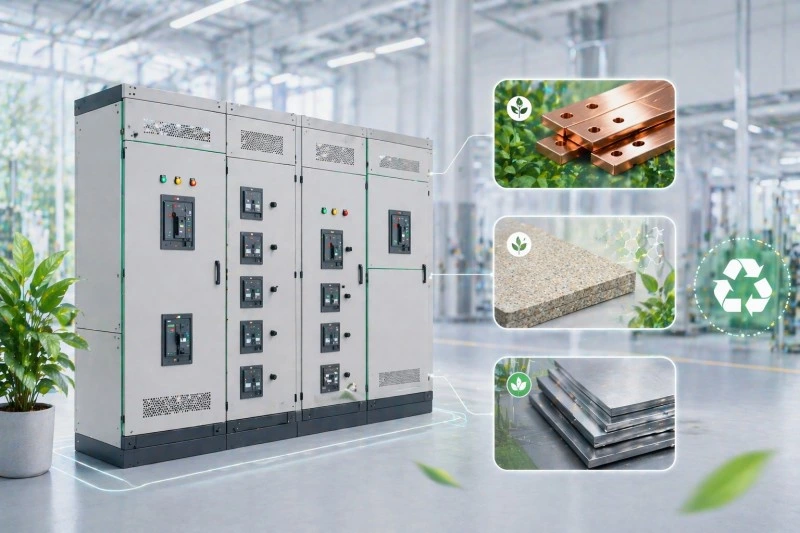
Sustainable and Recyclable Material Innovations
Next-generation LV switchboard designs incorporate bio-based composites, recycled copper busbars, and low-carbon steel enclosures. These materials maintain mechanical strength and electrical performance while significantly lowering embodied carbon and raw-material costs. Manufacturers can now offer greener LV switchboard solutions that appeal to environmentally conscious buyers without increasing price.
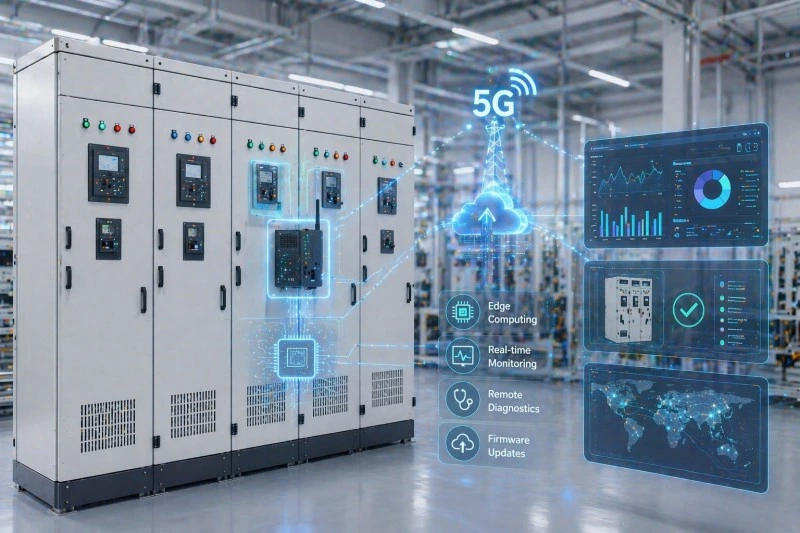
Edge Computing and Advanced IoT Integration
Edge computing modules embedded in the LV switchboard process data locally for instant fault detection and energy optimization. Combined with 5G connectivity, this enables remote firmware updates and self-diagnostic routines. The result is reduced on-site maintenance visits and lower long-term operational costs while boosting the LV switchboard’s reliable performance.
Adaptive Protection, Cybersecurity, and Circular Economy Innovations
Future LV switchboard designs will feature self-healing adaptive relays that learn from operational data and automatically reroute power around faults. Built-in cybersecurity protects connected systems, while modular refurbishment programs extend equipment life by 15–20 years at a fraction of new-unit cost. These combined innovations deliver powerful reliability and continuous cost efficiency across every industrial sector.
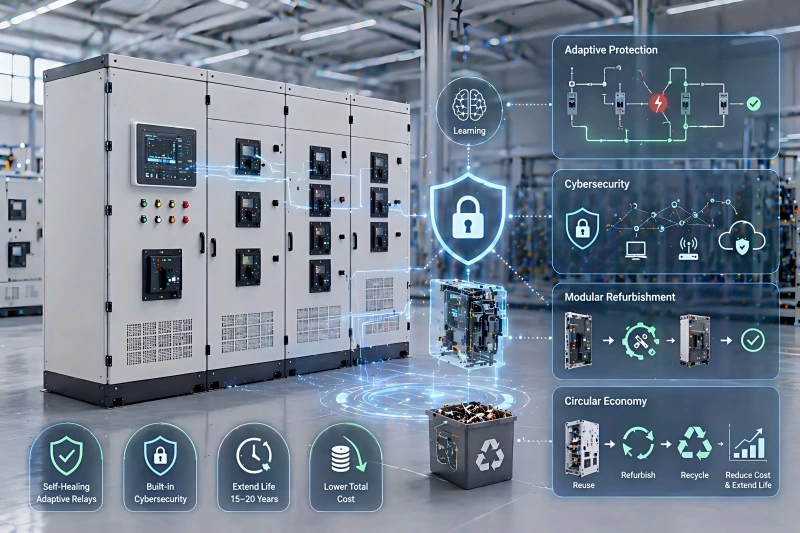
These future trends and innovations demonstrate that the LV switchboard of tomorrow will be smarter, greener, and more cost-effective than ever, delivering powerful reliability while continuously driving down total ownership costs.
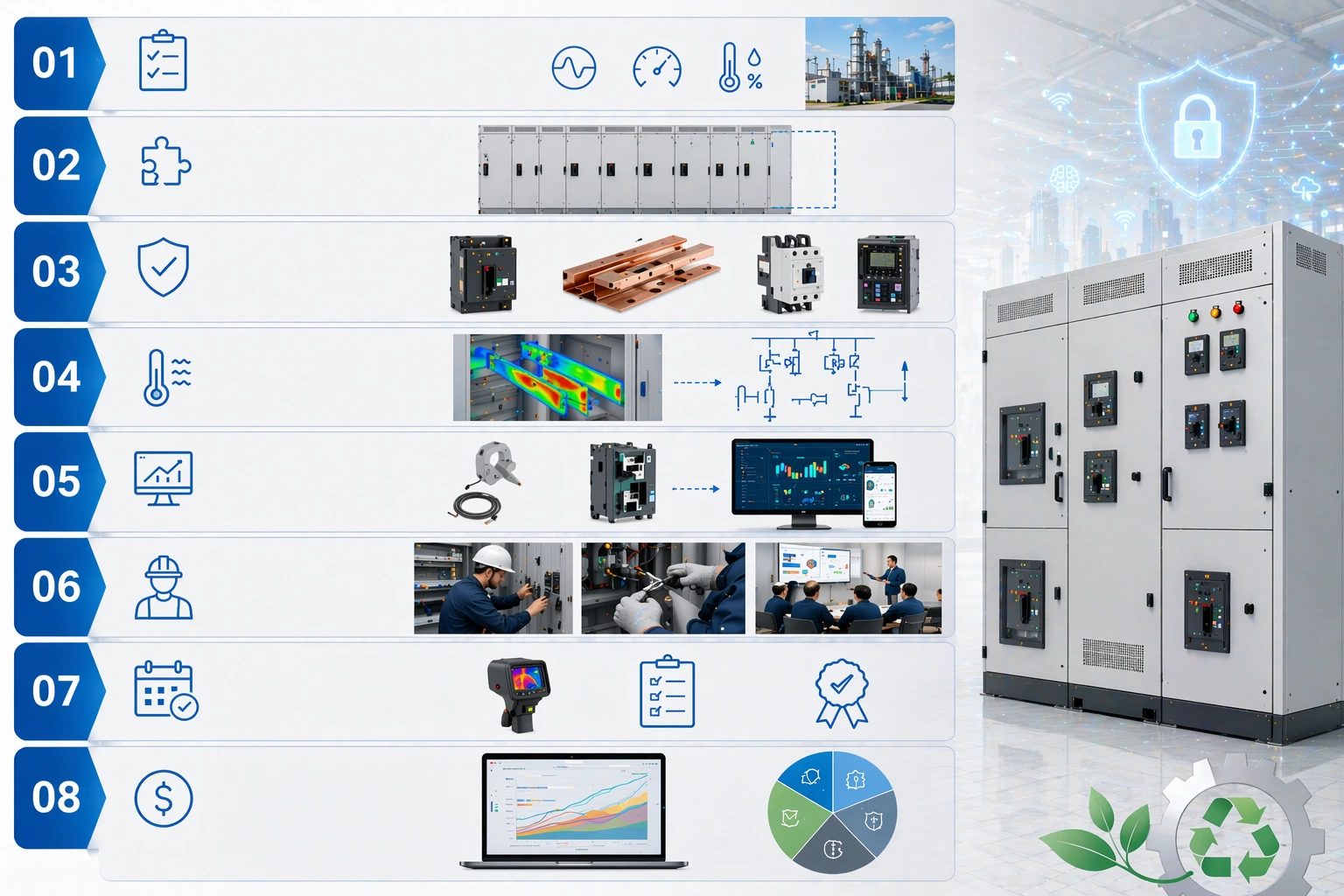
10.Actionable Checklist: Building Your Next High-Performance, Cost-Effective LV Switchboard
Step 1: Clearly Define Load, Voltage, and Environmental Requirements
Begin by listing exact incoming voltage, total load in kVA, peak current, and future expansion needs for the LV switchboard. Note site conditions such as dust level, humidity, vibration, and ambient temperature. This upfront clarity prevents oversizing or undersizing and keeps the LV switchboard design both powerful and cost-controlled from the start.
Step 2: Select Modular and Standardized Architecture
Choose a modular LV switchboard frame with standardized compartments for incoming, outgoing, and control sections. Verify that the design supports easy addition of circuits later. Modular construction reduces custom engineering costs while maintaining mechanical strength and reliable performance across mining, construction, agriculture, or renewable energy sites.
Step 3: Specify High-Quality yet Cost-Optimized Components
List required circuit breakers, busbars, contactors, and relays with exact ratings and certifications. Prioritize proven brands that balance breaking capacity, thermal performance, and price. Cross-check against IEC 61439 standards to ensure the LV switchboard delivers long-term reliability without premium pricing on every part.
Step 4: Optimize Busbar, Thermal, and Protection Design
Calculate busbar sizes and layout for minimal losses, then add intelligent thermal management and zone-selective interlocking. Run simulation checks to confirm no hot spots or coordination gaps. These targeted optimizations make the LV switchboard powerful and reliable while trimming material and energy costs.
Step 5: Integrate Smart Monitoring and Predictive Tools
Add affordable temperature sensors, current monitors, and Modbus communication modules to the LV switchboard. Confirm the system supports remote alerts and data logging. This step turns the LV switchboard into a proactive asset that reduces unplanned downtime and lowers lifetime maintenance expenses.
Step 6: Plan Installation, Commissioning, and Training
Prepare a detailed installation checklist covering foundation, cable routing, grounding, and torque values. Schedule full commissioning tests and operator training before energizing the LV switchboard. Proper planning avoids on-site mistakes and ensures safe, reliable start-up within budget.
Step 7: Establish Ongoing Maintenance and Compliance Schedule
Create a simple 3-month, 6-month, and annual maintenance calendar with torque checks, thermal imaging, and protection testing. Keep digital records of all work. Regular adherence to this schedule plus verification of international certifications keeps the LV switchboard safe, compliant, and cost-effective for decades.
Step 8: Calculate and Compare Total Cost of Ownership
Before final approval, compare at least three LV switchboard quotes using a 10-year total ownership model that includes energy losses, maintenance, and downtime risk. Select the option that delivers the best balance of powerful design, reliable performance, and lowest long-term cost.
Follow this actionable checklist step by step and you will build a high-performance, cost-effective LV switchboard that delivers reliable power, protects your investment, and supports your operations for years to come.
Conclusion
A powerful LV switchboard design delivers reliable performance and strict cost control across mining, construction, agriculture, and renewable energy projects. By applying the proven strategies, key components, best practices, and actionable checklist outlined here, facilities gain safe, efficient, and future-ready power distribution that protects operations and budgets for decades. Choose wisely—your next LV switchboard will define long-term success